Petty Island

Working in a team of three, my partners and I recreated Petty Island, an existing island in the Delaware River and adjacent to Fishtown, Philadelphia. Tasked with having to reduce the island to 80% of its original size and turning it into a College for Stormwater Management, we chose to reserved half the island for natural wildlife preservation.
The majority of the campus resides on existing hardscape with small research facilities scattered throughout the island and focusing on different areas of Stormwater Management. Two low-depth canals cut through the island with floating wetlands designed to filter the Delaware River as the current flows into the canals.
Using topography as a guide, the high points of elevation are the primary paths of travel for pedestrians, leaving the lower points of elevation as preservation for wildlife. A five-foot catwalk along the top points of elevations connect the three sections of the island that the canals create to the main campus on the island.

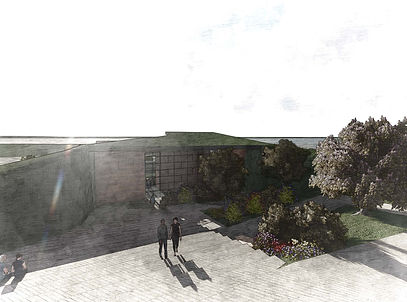
Taking on one of the research facility as an individual project from my team, I focused on a building that resides along one of the canals at the lowest point of elevation in the preservation sector of the island.
Submerging the building into the site, eco-bridges form up along the north and south sides of the building to branch across the canal to the other side for wildlife access from one section of the island to the other. An outside collaborative and study space was created with impervious surfaces at the edge of the canal along the south side of the building. Rain gardens surround the building as both a research tool for students and to also help camouflage the building from the wildlife.


Stepping down into the side to enter the building, three floors separate the different functions of the open concept building within the interior. The entry floor level sits at water level with the Delaware River and houses a facility office space, maintenance spaces, a materials library, kitchen area, along with the restrooms.
The mid-level floor steps down further with a collaborative seating area and individual workstations.
The lowest level stops at the bottom of the adjacent canal. A full glass wall along the face of the canal allows students to see the bio wetlands, the aquatic life, and how the two interact. Workstations and research stations on this level allow the students to function as a ground in creating additional bio wetlands, rain gardens, and etc while physically residing next to their research in function.